
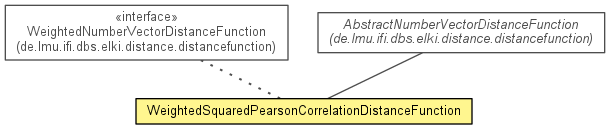
public class WeightedSquaredPearsonCorrelationDistanceFunction
extends AbstractNumberVectorDistanceFunction
implements WeightedNumberVectorDistanceFunction<NumberVector>
r as: 1-r
2. Hence, possible values of this distance are between 0
and 1.
The distance between two vectors will be low (near 0), if their attribute
values are dimension-wise strictly positively or negatively correlated. For
Features with uncorrelated attributes, the distance value will be high (near
1).
This variation is for weighted dimensions.| Modifier and Type | Class and Description |
|---|---|
static class |
WeightedSquaredPearsonCorrelationDistanceFunction.Parameterizer
Parameterization class.
|
| Modifier and Type | Field and Description |
|---|---|
private double[] |
weights
Weights
|
WEIGHTS_ID| Constructor and Description |
|---|
WeightedSquaredPearsonCorrelationDistanceFunction(double[] weights)
Constructor.
|
| Modifier and Type | Method and Description |
|---|---|
double |
distance(NumberVector v1,
        NumberVector v2)
Computes the squared Pearson correlation distance for two given feature
vectors.
|
boolean |
equals(Object obj) |
dimensionality, dimensionality, dimensionality, dimensionality, getInputTypeRestrictioninstantiate, isMetric, isSymmetricclone, finalize, getClass, hashCode, notify, notifyAll, toString, wait, wait, waitgetInputTypeRestrictioninstantiate, isMetric, isSymmetricpublic WeightedSquaredPearsonCorrelationDistanceFunction(double[] weights)
weights - Weightspublic double distance(NumberVector v1, NumberVector v2)
r as: 1-r
2. Hence, possible values of this distance are between 0
and 1.distance in interface NumberVectorDistanceFunction<NumberVector>distance in interface PrimitiveDistanceFunction<NumberVector>distance in class AbstractPrimitiveDistanceFunction<NumberVector>v1 - first feature vectorv2 - second feature vectorCopyright © 2015 ELKI Development Team, Lehr- und Forschungseinheit für Datenbanksysteme, Ludwig-Maximilians-Universität München. License information.